ADHD in the Workplace:
The Complete Evidence-Based Guide for Professionals
Managing ADHD in professional settings isn't about 'trying harder', it's about understanding how your brain works and building systems that fit you.
By Charlotte Moore, ADDCA-Certified ADHD Coach | 10+ Years Corporate Strategy ExperienceLast Updated: 28 January 2026 How ADHD Manifests at Work (Beyond "Can't Focus")
Most workplaces are built for neurotypical brains. Fixed meeting times, email systems, deadlines, and open-plan offices all assume a baseline level of executive function that people with ADHD often lack, regardless of intelligence, dedication, or ability.
The result? Millions of talented professionals are struggling not because they're not smart enough, but because their brains work differently. Understanding how ADHD manifests in professional environments is the first step toward effectively managing it.
🧠 What is Workplace ADHD?
ADHD (Attention-Deficit/Hyperactivity Disorder) is a neurodevelopmental difference affecting executive function, the mental processes that help us plan, prioritise, manage time, regulate emotions, and sustain attention on non-preferred tasks.
In the workplace, ADHD typically manifests as challenges with time perception, working memory, emotional regulation, and task initiation, not because someone isn't trying hard enough, but because their brain's dopamine regulation differs from the neurotypical baseline.
Key point: ADHD is not laziness, lack of intelligence, or a character flaw. It's a difference in how the brain processes information and manages executive functions.
This guide is designed for:
Professionals and executives managing ADHD in corporate or high-pressure settings
Knowledge workers struggling with deadlines, prioritisation, or email overload
Anyone told they're "Not living up to their potential" despite working harder than most
People recently diagnosed with ADHD who want practical, workplace-specific strategies
The 8 Core Ways ADHD Shows Up at Work
1) Time Perception and Planning Deficits
Often referred to as Time Blindness or Time Insensitivity. Time blindness isn't about forgetting time; it's about not perceiving time passing the way neurotypical people do.
"Now" vs "Not Now" perception: For many with ADHD, tasks either feel urgent (happening now) or distant (not yet real). There's little middle ground, making deadlines seem distant until they're suddenly due tomorrow.
The "One More Thing" Trap: You sit down to work for 30 minutes before a meeting, then suddenly it's time to leave because you lost track of time while hyper-focused. Or you're finishing "one more task" before starting the important project, then the day slips away.
The Deadline Cliff: You have a project due in two weeks. Since the deadline is in the “Not Now” zone, the brain perceives no urgency and views the available time as endless. You delay the project until the deadline approaches, then panic triggers enough adrenaline to focus.
Hyperfocus: Intense absorption in engaging tasks where hours go by like minutes. Useful for certain projects, but risky if it causes you to miss meetings or overlook other responsibilities.
2) Hyperfocus Vs Inability to Start
You can spend six uninterrupted hours working on a project you’re passionate about, yet you cannot, despite willpower or consequences, start the tedious but essential budget review that has been on your list for weeks.
Why is this?
ADHD brains have an interest-based nervous system, rather than an importance-based one. It is challenging to develop motivation based on importance, consequences, or future rewards.
ADHD brains require novelty, interest, urgency or passion to activate dopamine, which is essential for initiating and sustaining focus.
Impact:
Critical but dull tasks are often delayed until a panic-driven rush causes enough dopamine to motivate action.
High-interest but low-priority projects take up time that could be better utilised elsewhere.
3) Email and Communication Overwhelm
Your inbox fills up quickly despite good intentions to “stay on top of it”. Every email prompts a decision: respond now or later? What tone? How much detail? Is action needed or just acknowledgement?
Does any of this sound familiar?
Missing or miscommunicating important messages.
Avoiding opening emails due to feeling overwhelmed, which increases anxiety.
Flagging emails to respond to later and never opening them again.
Experiencing decision paralysis about how to reply.
Writing and rewriting responses repeatedly (perfectionism)
4) Working Memory Challenges
Working memory is like a mental sticky note; it's the information you're actively holding in mind. Working memory temporarily holds and processes information for goal-driven tasks, enabling us to maintain goals, retrieve and manipulate data, and solve problems.
Individuals with ADHD often struggle with this, forgetting instructions, losing track of steps or forgetting reasons for entering rooms. It’s about real-time information management, not long-term memory.
Capacity: An adult with ADHD can hold fewer items in mind at once (2 to 3), especially under stress or fatigue. If additional information is added, the earlier items tend to “fall off”.
Speed: The time it takes for the brain to process information. Processing information takes longer, especially with complex instructions or multi-step tasks.
Energy: Using working memory is cognitively demanding, leading to fatigue during prolonged mental effort.
The "shattering effect": Interruptions literally destroy your working memory. When someone asks a question, you lose the entire context you were holding, making it difficult to resume the task you were working on.
5) Difficulty with Prioritisation
When you examine your task list, everything seems equally urgent. Alternatively, nothing feels urgent until a deadline approaches.
The brain struggles to distinguish interest (what is stimulating) from importance (what is necessary).
Prioritisation relies on executive function: weighing importance, estimating time, assessing consequences and making strategic decisions.
Interest-based nervous system: Individuals with ADHD tend to prioritise what is engaging in the moment rather than what is strategically important.
Lack of “brakes”: The brain lacks the “brakes” to pause and decide whether a new stimulus is worth attention before engaging with it.
6) Rejection Sensitivity Dysphoria (RSD) at Work
❤️ What is Rejection Sensitivity Dysphoria (RSD)?
RSD is an extreme emotional reaction to perceived rejection, criticism, or failure that's disproportionate to the situation. It's not "being sensitive", it's a neurological difference in how the ADHD brain processes social and evaluative situations.
At work, RSD means: Critical feedback feels like personal rejection. A mild comment from your boss ruminates in your mind for days. Mistakes feel catastrophic and character-defining.
The workplace impact: Avoiding speaking in meetings, not sharing ideas, perfectionism, conflict avoidance, and difficulty accepting feedback. Over time, this damages career progression, relationships, and mental health.
RSD at work often manifests as:
Emotional flooding: Feeling disproportionately hurt by mild criticism
Rumination: Replaying conversations or feedback for hours or days
Conflict avoidance: Not addressing issues or giving feedback because the emotional risk feels too high
Perfectionism as protection: Trying to eliminate all possibilities of criticism, leading to overworking and burnout
Defensive reactions: Responding emotionally to feedback rather than thoughtfully
Career impact: Not applying for promotions, avoiding visibility, staying small to avoid criticism
7) Meeting Participation Challenges
Meetings combine multiple ADHD challenges: sustained attention on topics that may not interest you, time management pressure, working memory demands, and potential for RSD triggers.
Attention drift: Losing focus on discussions, especially when listening without active participation
Impulsive interrupting: Speaking without thinking, then regretting contributions (often perceived as rude or off topic)
Forgotten action items: Leaving meetings without clear next steps or having immediately forgotten what was agreed upon
Drained by back-to-back meetings: Requiring recovery time, but having packed schedules with no breaks
Ideas after the meeting: Good contributions come to mind after the meeting ends
8) Inconsistent Performance (The Performance Paradox)
Perhaps the most damaging ADHD pattern in workplace settings. The performance paradox occurs when someone seems brilliant one week and struggles the next, sometimes on the same tasks.
Seemingly random variations: Same task, at different times, produces different results. It's not about effort or skill; rather, it's about dopamine levels, stress, sleep quality, and executive function load.
Misattribution: Managers and peers often assume that inconsistency indicates low motivation, lack of commitment, or insufficient ability. These assumptions damage trust and harm career perception.
Career impact: Being perceived as unreliable, even when the work is exceptional, when it happens. Promotions go to consistent performers, even if their base performance is lower.
Self-doubt: Living with the contradiction between being able to produce brilliant work and struggling with everyday tasks causes confusion and shame about identity and ability.
Navigating Specific Workplace Situations with ADHD
Understanding how ADHD manifests is crucial. Equally important is knowing how to manage it daily. The strategies provided are not just generic productivity tips rephrased for ADHD. Instead, they are practical methods tailored to how ADHD neurology influences typical workplace situations, such as meetings, emails, deadlines, feedback, relationships, and work environments. Remember, not every strategy will work for everyone.
Try them out, adjust as needed, and keep what works.
1) Managing Meeting Effectively
Meetings are where ADHD challenges converge: maintaining attention on potentially dull content, managing working memory for action items, controlling impulsivity during discussions, and addressing time blindness in scheduling.
Here's how to handle them more effectively:
-
Request or create an agenda in advance
Review relevant background materials the day before (not 5 minutes before)
Set a calendar reminder 5 minutes before (transition to the meeting)
If virtual, enable video to improve engagement
Prepare one relevant point or question you want to contribute
-
Take active notes: Writing helps maintain physical focus. Don’t aim for perfect notes; simply jot down key points and action items.
Use the “doodle method”: If your attention drifts, doodle or use fidget tools (fidget cube, stress ball) while listening. Movement helps many ADHD brains sustain focus on auditory information.
Use body doubling: have a video on, visible engagement, or someone next to you to help sustain attention. External accountability reduces the temptation to multitask or zone out.
Stand, if possible, to maintain alertness and concentration.
Before interrupting, write it down: when an idea comes suddenly, write it down instead of speaking immediately. This relieves the I’ll forget this” anxiety while allowing others to finish.
Record meetings when possible (with permission): for meetings where you might miss details, recording allows you to review important information without having to ask colleagues to repeat themselves.
-
Immediately capture action items before leaving the room or closing the video call. Your working memory won't hold them for long.
Establish accountability: If you commit to something, schedule it immediately or message someone to check in with you on it.
Review recorded meetings: use Zoom AI meeting summary to quickly review next steps and action items
2) Email and Communication Management
Your inbox will never be empty, and that's okay. The aim isn't inbox zero; it's an inbox where nothing gets lost, and you're not overwhelmed.
-
Stop constantly monitoring emails
All-day vigilance leads to decision fatigue and disrupts deep work.
Schedule specific email blocks: 9.30 am, 1 pm and 4pm
Close your email between these periods
Use an autoresponder if needed: “I check my email three times daily. If you need to contact me, please call”
-
Every email requires a decision. Make it binary: action required now, or not?
If it takes less than 2 minutes, do it immediately: reply, forward, file. Done.
If it takes longer, don't open it fully: skim, flag, or star it, then move on. You'll address it during your dedicated "email action" block, separate from processing.
If it's FYI/no action needed, archive immediately: don't let "might be useful later" emails clog your inbox.
-
For recurring email types such as meeting requests, status updates, and client check-ins, create templates.
Gmail and Outlook both support this.
It reduces decision fatigue and speeds up response time.
You're not being impersonal; you're being efficient.
-
Unsubscribe from all non-essential emails: If you haven't opened messages from a sender in 3 months, unsubscribe.
Use filters to automatically sort items: Newsletters, team updates, automated notifications, and organise them into folders so they don't clutter your inbox.
Forward or delegate when appropriate: If someone else should handle it, pass it on immediately rather than holding onto it mentally.
Accept imperfection: You will miss emails. You will occasionally respond late. Build in buffers and repair trust when it happens, but don't let perfection paralysis prevent you from responding at all.
3) Project Management and Deadlines
Large projects overwhelm ADHD brains. Vague timelines encourage procrastination. Traditional project management assumes consistent executive function and linear progress, assumptions your brain doesn't support.
Here's what works instead:
-
Begin with the most engaging part, rather than the "logical" initial step. Momentum is more important than sequence at the start.
Alternate between dull and interesting tasks: after a tedious section, reward yourself with a more enjoyable part. This helps maintain dopamine levels.
Keep each segment small enough to feel achievable, ideally 25-90 minutes of focused work.
Preparation and Recovery: Accept that you may wait until a deadline looms to start because you need the adrenaline to focus. To use this strategically, clear your schedule before the sprint to remove distractions, and crucially, schedule "recovery time" or "percolation" immediately after the sprint to avoid burnout.
-
Whatever deadline you're given, mentally halve it.
If something is due on Friday, consider Wednesday as your deadline.
When time blindness causes tasks to take longer than expected, you gain a buffer instead of facing a crisis.
-
Pomodoro Technique: 25-minute focused work blocks with 5-minute breaks. The time boundary and structure provide external regulation.
The 10-Minute Rule: Commit to starting for just 10 minutes. Most people with ADHD find that once started, continuation is easier.
"Beat the Clock": Gamify the work by challenging yourself to complete a section by a specific time. The time pressure provides dopamine.
Accountability partnerships: Share deadlines with someone else. The social pressure and check-ins provide external motivation.
4) Performance Review and Feedback
Performance reviews are RSD minefields. Even constructive feedback can feel like criticism, leading to emotional dysregulation. Here are several strategies to prepare for these evaluations and turn them into manageable, constructive conversations.
-
Prepare for RSD Activation: Recognise that your brain may perceive feedback more negatively than intended. This isn’t paranoia. Being aware of this helps you observe your reaction rather than be overwhelmed by it.
Gather Data and Request Feedback in Advance: Processing feedback in real-time taxes working memory and emotional regulation simultaneously. Written feedback allows you to process at your own pace and prepare thoughtful responses.
Bring Your Own Wins: ADHD brains often overlook achievements. Write down specific accomplishments before the review so you can refer to them when RSD makes you forget everything you’ve done well.
Remember: feedback on performance isn't feedback on your worth as a person
-
Write down key feedback as it's given (helps working memory and keeps you engaged)
Ask clarifying questions: when feedback feels vague or harsh, ask: Can you provide a specific example? And what would success look like in this area? This turns abstract criticism into actionable information.
Pause: Don't commit to responses in the moment if emotionally triggered
Request time to process before responding to significant feedback
-
Wait at least 24 hours before reacting emotionally to feedback: Allow yourself time to regulate before deciding how to respond or whether to discuss further.
Follow up in writing: Email your manager summarising what you heard and your planned actions. This confirms understanding and provides both of you with documentation.
Identify one concrete action for areas of growth: focus on the most impactful feedback and disregard the others for now.
Schedule a follow-up with your manager in 30 days to discuss progress
5) Professional Relationship and Office Politics
ADHD traits such as impulsiveness, oversharing, rejection sensitivity, and missing social cues complicate workplace relationships. You can't alter your neurology, but you can develop strategies that minimise friction and repair damage when it occurs.
-
The 2-second pause: Before responding (especially in emotionally charged discussions), count to two silently.
"Let me think about that and get back to you": When someone asks a question and your impulse is to answer immediately, this phrase buys processing time.
Use email for sensitive topics when possible: Written communication forces a pause that in-person conversations don't. You can draft, revise, and delete before sending.
-
ADHD makes relationship building harder (it requires working memory and follow-through). Intentionally strengthen key relationships:
Schedule regular 1:1 coffee/lunch meetings, don't wait for organic contact
Set calendar reminders to ask about projects people mentioned
Send a note recognising someone's work within a week of observing it
-
You will sometimes interrupt, miss social cues, forget commitments, or react emotionally. Repairing things is more important than aiming for perfection.
Apologise specifically and briefly: I interrupted you during yesterday's meeting. That was rude, and I apologise. I'm working on it. Then move on; don't over-apologise, as that becomes its own burden.
Don't over-explain ADHD unless disclosure is strategic: most colleagues don't require a neurological explanation. A simple "I'm working on that" suffices.
6) Remote, In-Office & Hybrid Work
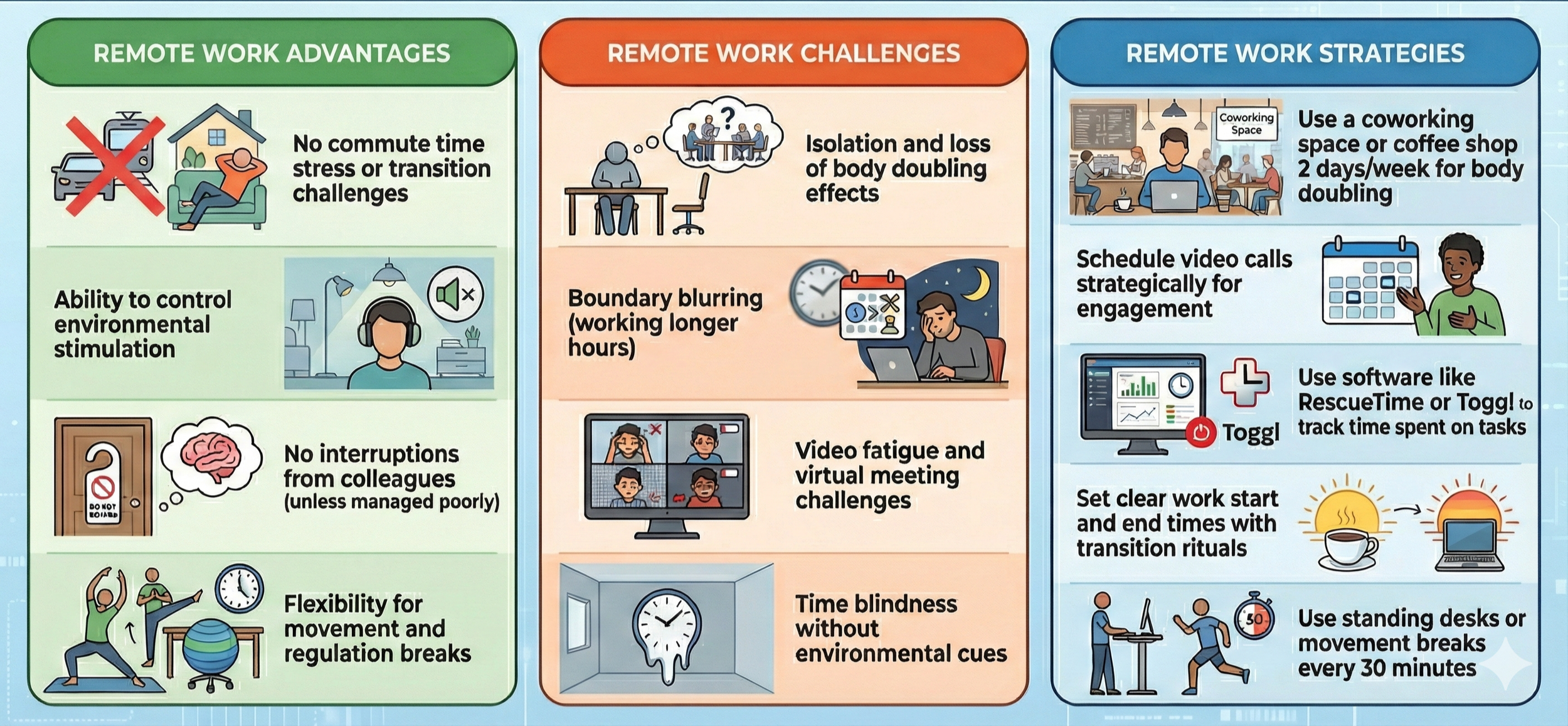
Remote work advantages, challenges and strategies
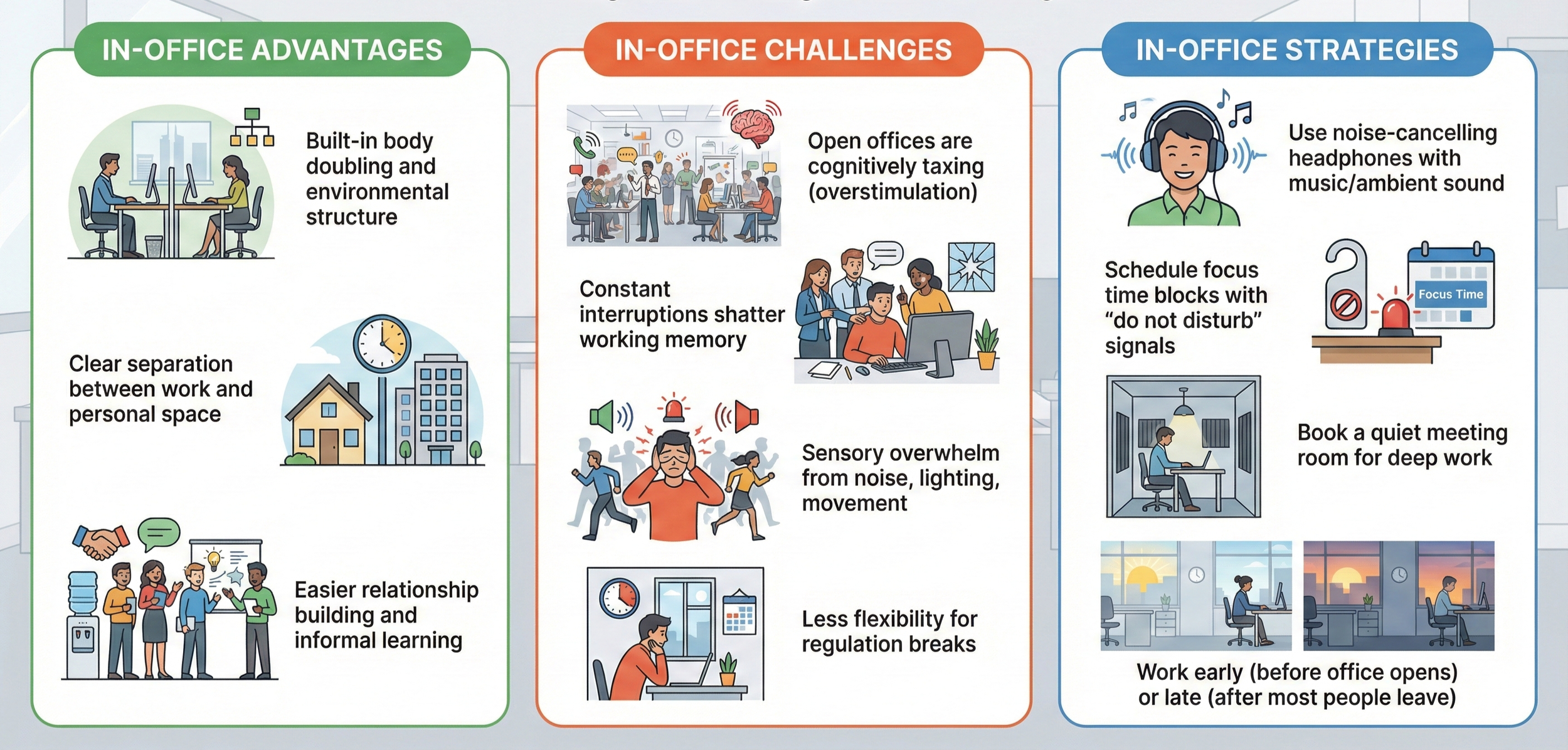
In-office advantages, challenges and strategies
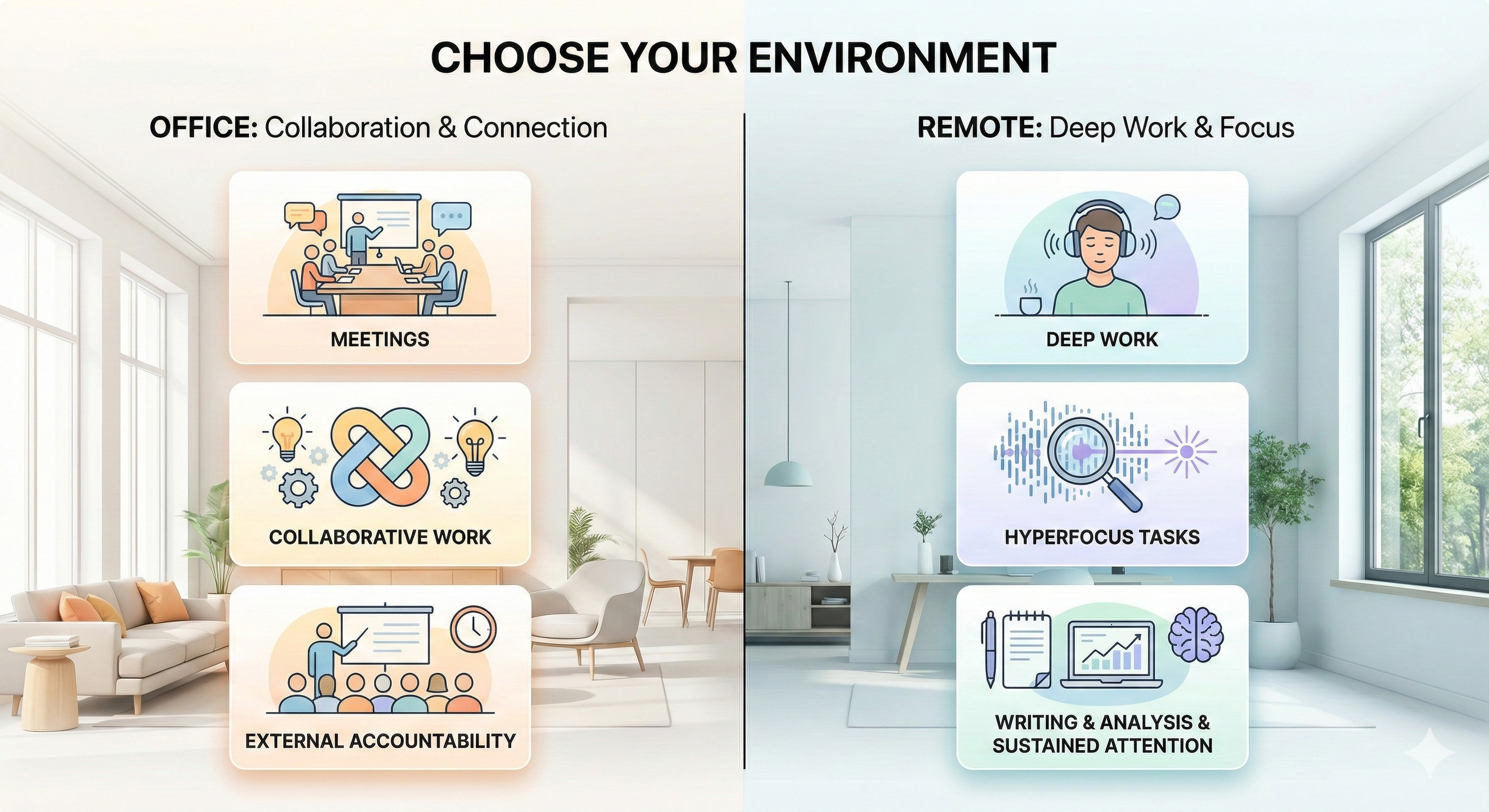
Hyrbbrid Models (optimising both): if you have flexibility, use each environment to your advantage
Struggling to implement these strategies on your own?
Professional ADHD coaching can help you build personalised systems that actually work with your brain, not against it. Unlike generic productivity advice, coaching addresses your specific ADHD manifestation, workplace context, and goals.
Evidence-Based Strategies That Actually Work
The strategies below aren't about "trying harder" or "being more disciplined." They're based on how ADHD brains actually function, using interest, novelty, urgency, and structure instead of fighting your neurobiology. None of these strategies will work all the time perfectly, and that's normal. The goal is to find what works for you most of the time, in most situations. Experiment, learn, and keep what suits you.
Build Interest Into Boring Tasks
Since ADHD is fundamentally about dopamine dysregulation, making tasks more interesting isn't a workaround; it's addressing the root cause.
Gamification: Add scoring, challenges, or progress tracking. Example: "Can I respond to 10 emails in 20 minutes?" or use a habit tracker that shows streaks.
Dopamine Pairing: Pair a boring task with something enjoyable. Work on the annual report at your favourite coffee shop or listen to a podcast while processing expenses
Novelty Injection: Change the environment, tool, or approach. Work in a different location, use a new app, or change your reward after completion.
Competition: Race against the clock, compete with a peer, or challenge yourself against your previous time. The competitive element provides dopamine.
Social Accountability: Tell someone what you're doing and report back. The social element increases dopamine availability and reduces avoidance.
External Structure Replaces Internal Discipline
ADHD doesn't mean lack of discipline; it means discipline requires more effort because it's fighting against dopamine dysregulation. An external structure automates decisions and reduces reliance on willpower.
Time-Blocking Your Calendar: Schedule everything, including focused work, exercise, and breaks. This eliminates the dilemma of "what should I do now?" and sets clear time limits that externally guide you.
Calendar as External Brain: Instead of relying on memory, every commitment goes into the calendar. Set reminders for preparation. Block transition time between activities.
Body Doubling: Working alongside someone else (in person or virtually) significantly improves focus and task completion for many people with ADHD. Even passive body doubling (someone working nearby without interaction) helps.
Physical Environment Design: Organise your workspace so tools are immediately visible and accessible. Remove distracting elements. Create a dedicated focus space if possible.
Implementation Intentions: Plan not just what to do, but the exact time, place, and trigger for doing it. "I will respond to emails Monday at 9:30 am at my desk after my first coffee" is more effective than "I'll manage my emails better."
Reduce Cognitive Load and Decision Fatigue
Every decision, even minor ones, depletes executive function. ADHD brains start each day with less executive capacity than neurotypical brains, and it diminishes more quickly. By removing unnecessary decisions, you conserve cognitive resources for what truly matters.
Routines: Automate recurring decisions through routines. Same lunch time, same morning startup sequence, same email-checking times. This frees mental energy for creative and strategic work.
Task Batching: Group similar tasks together. Do all emails at once, all phone calls at once. This reduces context switching, which is cognitively expensive.
Templates and Standard Operating Procedures (SOPs): For recurring tasks, develop templates or processes to follow. Project proposals, status reports, and meeting agendas; templates help reduce decision-making and execution time.
Delegation and Automation: Identify tasks that don't use your best skills or add the most value. Delegate or automate them. This isn't about avoiding work; it's about strategically allocating your limited executive function.
Information Triage: Limit information inputs. Unsubscribe from newsletters, mute notifications, and curate news sources. Every piece of information requiring processing is a cognitive load.
Leverage Hyperfocus Strategically
Hyperfocus is ADHD's superpower, the ability to work with intense concentration for extended periods when genuinely engaged. The challenge is that hyperfocus can activate unpredictably and become fixated on low-value tasks. When leveraged strategically, it's your competitive advantage.
Recognise It: Notice when you're hyper-focusing (time passes quickly, you lose awareness of hunger/discomfort, work feels effortless). This is your optimal working state.
Protect It: Schedule blocks for hyperfocus work when you know you'll be interested. Block calendar time, mute notifications, and communicate "do not disturb" clearly.
Direct It: Intentionally schedule your most important or challenging work during times you're likely to hyperfocus. Boring administrative work during lower-focus periods.
Manage the Transition: Hyperfocus ends abruptly when external disruptions occur (meeting time, notifications). Use timers to warn yourself and prepare for task switching.
Use Alarms: Set alarms 15 minutes before you need to stop hyper-focusing to give yourself transition time and prevent being late to commitments.
Emotional Regulation for RSD and Overwhelm
ADHD emotions are bigger, faster, and harder to regulate than neurotypical emotional responses. The following strategies help manage the emotional dysregulation that often accompanies ADHD.
Name the Emotion: Research shows that labelling emotions reduces their intensity. "This is frustration and anxiety, not a character flaw" is a powerful reframe. Use emotions as data, not identity.
The 24-Hour Rule: Don't make decisions, send messages, or respond to criticism when emotionally activated. Wait at least 24 hours. Most ADHD emotional storms pass if you wait.
Reframing: Challenge the catastrophic thinking that often accompanies RSD. A critical comment on a project doesn't mean you're incompetent. A mistake doesn't define your career.
Self-Compassion: ADHD makes life harder in specific ways. Be genuinely kind to yourself about these challenges. The shame is often more damaging than the ADHD itself.
Physical Regulation: Movement, cold water, and deep breathing change your nervous system state. When emotionally flooded, use physical interventions before cognitive strategies.
Should You Disclose Your ADHD At Work?
This is one of the most consequential decisions many people with ADHD face.
It's deeply personal and has real professional implications. Here's a framework for thinking through it.
⚖️ Do I Have to Tell My Employer?
In the UK: No. You are not legally required to disclose ADHD or any disability to your employer. However, if you want to access legal protections under the Equality Act 2010 or claim Access to Work funding, you'll need to disclose to your employer or the government, respectively.
Pros of Disclosure
Legal Protections: Once disclosed (in writing), you're covered under the Equality Act 2010. Your employer can't discriminate, and they must make reasonable adjustments.
Reduced Masking Burden: Stops the exhausting effort of hiding ADHD symptoms. Many people report immediate relief from disclosure.
Access to Accommodations: Adjusted deadlines, quiet space, different meeting formats, and flexible hours become legitimate and protected.
Access to Work Funding: If eligible, can fund ADHD coaching, assistive technology, or support services. This is a significant financial benefit.
Understanding: Managers who understand ADHD interpret inconsistent performance differently. "They're not lazy, their dopamine regulation is affected by how interesting the task is", changes everything.
Cons and Risks Disclosure
Stigma: Despite progress, many employers hold negative views about ADHD. Assumptions that you're less capable, less reliable, or less professional.
Perception Impact: Being perceived as less capable or needing accommodation can damage career progression. Promotions might go to non-disabled peers.
Loss of Control: Once disclosed, the information is out. Colleagues, supervisors, and HR all know. You can't take it back.
Relationship Changes: Some managers become more cautious around you, shift your assignments, or relate to you differently (some positively, some negatively).
Lack of Guarantee: Disclosure doesn't guarantee accommodations are appropriate or helpful. You might disclose and still struggle without good support.
When Disclosure Usually Makes Sense
Disclosure is a personal decision, but it typically makes sense when:
Supportive Culture: Your organisation has neurodiversity initiatives, celebrates differences, or your industry values diversity (tech, nonprofits, progressive companies).
You Need Accommodations: You can't manage effectively without adjustments such as flexible hours, a quiet space, or alternative meeting formats.
Access to Work Eligibility: You qualify for the scheme and would benefit from funded support. The financial benefit outweighs the risk.
Strong Manager Relationship: Your direct manager already knows you're capable and values your contribution. They're likely to respond supportively.
Career Not at Risk: You're performing well or in a secure role. Disclosure won't put you in a vulnerable position.
New Role Exposed Challenges: You were managing fine until you got promoted, changed departments, or the work changed. Disclosure explains the change and frames it as an adaptation rather than a decline.
When Disclosure is Riskier
Competitive, high-performance environments where any accommodation is seen as an unfair advantage
Organisations with a poor diversity and inclusion track record
Managers with proven negative attitudes about disability or mental health
During a performance struggle or probation
In roles where perception is everything (senior leadership, client-facing positions)
UK Workplace Rights and Access to Work
Your Legal Rights as an Employee with ADHD in the UK
If you're employed in the UK with ADHD, you have legal protections and access to government funding that many people are unaware of. Knowing your rights and how to exercise them can improve your work experience and enable you to access professional support at no cost to you.
This section explains the protections under the Equality Act 2010 and the Access to Work scheme, which can fund ADHD coaching, assistive technology, and workplace accommodations.
1) Equality Act 2010 Protection
Does ADHD Qualify as a Disability?
ADHD qualifies as a disability under the Equality Act 2010 if it has a "substantial and long-term adverse effect" on your ability to carry out normal day-to-day activities. In practice, this means:
Substantial: Having more than a minor or trivial impact. If ADHD affects your ability to concentrate, manage time, organise tasks, regulate emotions, or maintain consistent performance, it probably meets this threshold.
Long-term: Lasting or expected to last at least 12 months. ADHD is a lifelong neurodevelopmental condition, so this criterion is usually satisfied.
Adverse effect on day-to-day activities: Includes work activities. Executive function challenges, time blindness, working memory deficits, and emotional dysregulation all qualify.
What Protections Apply?
Discrimination: Your employer cannot discriminate against you because of ADHD. They can't treat you less favourably, and this applies to hiring, pay, promotion, and dismissal.
Reasonable Adjustments: Your employer must make reasonable adjustments to support you. These are changes to how work is done that remove or reduce disadvantage without creating undue cost or burden.
Protected Disclosure: Once you disclose in writing, you're protected. Your employer can't "forget" or change their mind; they're legally bound.
Important Note
Protection under the Equality Act is activated by disclosure. If you don't tell your employer, the legal protections don't apply. Disclose in writing (email is sufficient) to a manager or HR to trigger protections.
2) Reasonable Accommodations: Examples by Challenge
For Time Blindness and Planning Deficits
Extended deadlines or earlier notice of upcoming work
Regular check-in meetings to review progress
Flexibility with start/finish times
Warning for upcoming commitments or changes
For Attention and Focus Challenges
Quiet space or remote working option
Written agendas before meetings
Meeting notes sent in writing after
Block calendar time for focus work
One-to-one communication instead of group meetings, where possible
For Working Memory Challenges
Written instructions for tasks
Permission to take notes in meetings
Limiting the number of tasks or priorities given at once
Regular reminders about deadlines
Written summaries of decisions or actions agreed upon
For Communication Challenges
Written communication preferred over verbal
Asynchronous communication (email) rather than real-time chat
More time to respond to messages before action is expected
Ability to draft and review communication before sending
For Emotional Regulation and RSD
Feedback in written form, where possible
Advance notice of reviews or critical conversations
Regular positive feedback and recognition
Permission to take a break if emotionally activated in meetings
Time to process feedback before responding
For Movement and Physical Needs
Standing desk or the ability to move regularly
Fidget tools or movement breaks built into the schedule
Permission to walk or move during calls
Flexibility with physical positioning in meetings
3) Access to Work Scheme Overview
What is Access to Work?
A government scheme (run by the Department for Work and Pensions) that funds support for disabled people in employment. This includes ADHD coaching.
What does it cover?
ADHD coaching and support
Assistive technology
Communication support (note-takers, interpreters)
Transport to work (if relevant)
Support workers (if relevant)
Eligibility:
You’re eligible if you:
Are employed or self-employed (at least 16 hours per week)
Are 16 years of older
Have an ADHD diagnosis (or assessment in progress, you can apply before diagnosis is finalised)
Live and work in England, Scotland or Wales (Ireland has a separate scheme)
Have ADHD that creates barriers to work performance
There are no income limits. Both high earners and low earners are equally eligible. Your employer's size doesn't matter. Whether you're permanent, on a contract, or self-employed, it doesn't make a difference. If you meet the criteria above, you qualify.
Funding Limits:
The scheme has funding limits (varies by support type and year)
For coaching, typical funding covers 15-20 sessions annually
You may need to contribute some cost if it exceeds the limit
4) How to Apply for Access to Work
The Access to Work application process is straightforward but requires patience; it typically takes 6-12 weeks from application to funding approval.
Here's the step-by-step process:
-
You'll need documentation confirming your ADHD diagnosis. This can be:
A letter from a psychiatrist or clinical psychologist who diagnosed you
Copy of diagnostic assessment report
Letter from GP confirming diagnosis (if GP has diagnostic letter on file)
You don't need extensive documentation; a simple letter confirming an ADHD diagnosis and the date of diagnosis is sufficient.
If you're awaiting a formal diagnosis but have an assessment scheduled, you can still apply; note "diagnosis pending" in your application.
-
You can apply online or by phone:
Online: gov.uk/access-to-work
Phone: 0800 121 7479 (textphone: 0800 121 7579)
Opening hours: Monday to Friday, 9 am to 5 pm
If applying by phone, the advisor will complete the form with you. If applying online, you'll fill out a form covering:
Your employment details (employer name, role, hours worked)
Your ADHD and how it affects your work
What support do you think you need (coaching, technology, etc)
Contact information
Be as specific as possible about how ADHD impacts your work; don't minimise. The assessment is based on the barriers you describe.
-
After your application, Access to Work will arrange a needs assessment. This is typically:
Phone call or video assessment (30-60 minutes)
Conducted by an occupational therapist or an ADHD specialist assessor
Focused on understanding your specific workplace challenges
During the assessment, explain:
How ADHD manifests in your work (time management, organisation, focus, emotional regulation, etc.)
What accommodations would help (coaching, technology, environmental changes)
What you've already tried and what hasn't worked
Be honest and thorough. This assessment determines what support you'll be funded for. If you underplay difficulties, you may not get adequate support.
-
Access to Work reviews the assessment and decides:
Whether you're eligible (almost always yes if you have an ADHD diagnosis and are employed)
What support will be funded
Funding amount and duration (usually 12 months, renewable annually)
You'll receive a letter confirming:
Approved support (e.g., "12 months of ADHD coaching, up to £X")
How to access it (choosing an approved provider, submitting invoices)
Renewal process
-
Once approved, you can choose your ADHD Coach. Look for the following credentials:
Trained with ADDCA
ICF and/or PAAC certified
-
Work with your coach on specific workplace challenges and strategies. Share progress with Access to Work as required.
🎯 Access to Work Coaching
If you're eligible for Access to Work, ADHD coaching can be completely funded, removing the cost barrier to getting professional support. This is a significant benefit that many people with ADHD don't know about. Explore your eligibility and begin the application if you think it might help you.
When to Seek Professional ADHD Coaching
Self-management strategies work. Many people improve significantly through understanding and applying the evidence-based approaches above. But professional support accelerates progress and helps you navigate unique challenges.
Signs You Might Benefit from ADHD Coaching
Can't Maintain Strategies: You understand what works in theory but struggle to implement consistently. A coach provides accountability and personalisation.
Career Impact: Your ADHD is affecting your job performance, relationships, or progression. The stakes are high enough to warrant professional help.
Burnout from Masking: You're exhausted from the constant effort to hide ADHD or manage without support. The emotional cost is unsustainable.
RSD Damaging Relationships: Emotional reactions related to rejection sensitivity are affecting your professional relationships and career opportunities.
Job at Risk: Your ADHD is impacting your performance in ways that threaten your role. Quick, targeted help is needed.
New Role Exposed Challenges: You were managing fine until circumstances changed (promotion, new manager, role expansion). You need help adapting your strategies.
What ADHD Coaching Offers vs Therapy vs Self Help
Coaching focuses on present and future action, not past trauma:
Therapy explores the past to understand and heal emotional wounds. It asks, “Why do I struggle?” and processes trauma, childhood experiences or relationship patterns.
Coaching starts with present challenges and future goals. It asks, “What do I want to achieve, and what’s currently preventing that?
If you need to process past trauma, grief, or deep emotional work, therapy is suitable.
If you need to build systems for current workplace performance, coaching is appropriate.
Many people benefit from both simultaneously.
Personalised system design, not generic productivity advice:
Self-help books and articles provide generic strategies that may work for some neurotypical brains.
ADHD coaching, on the other hand, creates personalised systems specifically designed for your brain, role, environment, and goals.
A coach doesn't just give you a universal time management plan and leave you to implement it.
Instead, they collaborate with you to develop systems tailored to your situation, whether you're an executive managing teams, an entrepreneur handling multiple projects, an athlete managing training schedules, or a professional navigating corporate politics.
Because generic advice often doesn’t fit ADHD brains, personalised systems consider how ADHD manifests uniquely in each individual.
Accountability and experimentation:
Self-directed change is difficult for ADHD brains because executive function, the system that initiates, sustains, and monitors behaviour change, is impaired.
Coaching offers external accountability: regular sessions create deadlines, and reporting progress to another person creates the urgency needed for action.
Equally important, coaching provides space for experimentation. You try strategies, report back on what worked and what didn't, and iterate.
This trial-and-error process, supported by someone who understands ADHD neurology, speeds up learning significantly.
What coaching provides that therapy and self-help don't:
Forward-looking strategic planning (not processing past)
ADHD-specific expertise and neuroscience knowledge
Consistent external accountability structure
Real-time problem-solving for workplace challenges
Systems tailored to your brain, not abstract principles
Partnership model (collaborative, not expert-giving-advice)
What to Look for in a Coach
Relevant Credentials: Look for ADDCA (ADHD Coaches and Coaching Association), ICF (International Coaching Federation), or PAAC (Professional Association of ADHD Coaches). These indicate training, accountability and relevant credentials.
Professional Experience: Ideally someone with corporate or professional work experience. They understand workplace culture, politics, and dynamics, not just ADHD theory.
Evidence-Based Approach: They should reference research, not just personal philosophy. Ask about their approach and what evidence supports it.
Workplace Dynamics Understanding: They should ask about your specific role, culture, and challenges. One-size-fits-all coaching doesn't work for ADHD.
Access to Work Approval: If you're thinking about Access to Work funding, confirm they're an approved provider. This removes cost barriers.
Good Communication Match: Chemistry matters. A good coach is someone you feel understood by and want to work with regularly.
Key Takeaways and Next Steps
7 Core Principle for ADHD Success at Work
ADHD is a difference, not a deficit.
Your brain works differently, in some ways harder, in other ways easier; understanding this changes everything.
External Structure Beats Willpower.
Don't rely on discipline. Build systems, structures, and environmental supports that automate your success.
Interest and Dopamine Matter.
Make tasks interesting, use urgency strategically, and pair boring work with enjoyable elements.
Time Blindness is Real and Manageable
Stop thinking you'll "try harder" with time. Instead, build buffers, use calendar blocking, and create external time awareness.
Emotion Regulation is Learnable
RSD and overwhelm are ADHD features. With strategies and self-compassion, you can manage the emotional intensity.
Disclosure is a Personal Calculation
It's not a universal answer. Make the decision based on your specific situation, risk tolerance, and support needs.
You don’t have to figure this out alone
Professional support accelerates progress. Whether through coaching, therapy, or workplace accommodations, getting help is a strength.
Your Next Steps
Identify Your Top 3 Challenges:
From the manifestations described above, which three affect you most at work? Write them down. This is your starting point.
Pick One Strategy to Implement:
Choose one evidence-based strategy from this guide that addresses one of your top challenges. Implement it for 2 weeks and notice what changes. One change at a time is more sustainable than trying everything.
Assess Your Disclosure Situation:
Using the framework above, consider whether disclosure is appropriate for you. If so, plan how and when to do it. If not, think about adjustments you can request without disclosing or how to advocate for your needs.
Explore Professional Support:
If you're struggling despite self-management strategies, or if your situation is complex, consider whether ADHD coaching or therapy would help. Explore coaching options or learn more about working with Charlotte Moore.
Final Word
Managing ADHD in professional environments is possible. It's not about "trying harder" or "just focusing better." It's about understanding how your brain works and building systems, strategies, and support that fit you. Many people with ADHD do exceptional work; they just need to understand themselves better and structure their environment accordingly.
Your ADHD is real. The challenges are real. And the solutions are real too. Start small, be consistent, and be kind to yourself in the process.
Ready to Transform Your Workplace Experience?
Whether you’re exploring coaching, need workplace accommodation support or want to discuss your specific situation, Charlotte Moore is here to help. Schedule a free consultation to discuss next steps.