
Latest Research: What 580,000 People Tell Us About Late ADHD Diagnosis
A 2026 study from the University of Helsinki tracked 580,000 people and found something that ADHD advocates have long suspected: every year of delayed ADHD diagnosis is associated with measurably worse life outcomes.
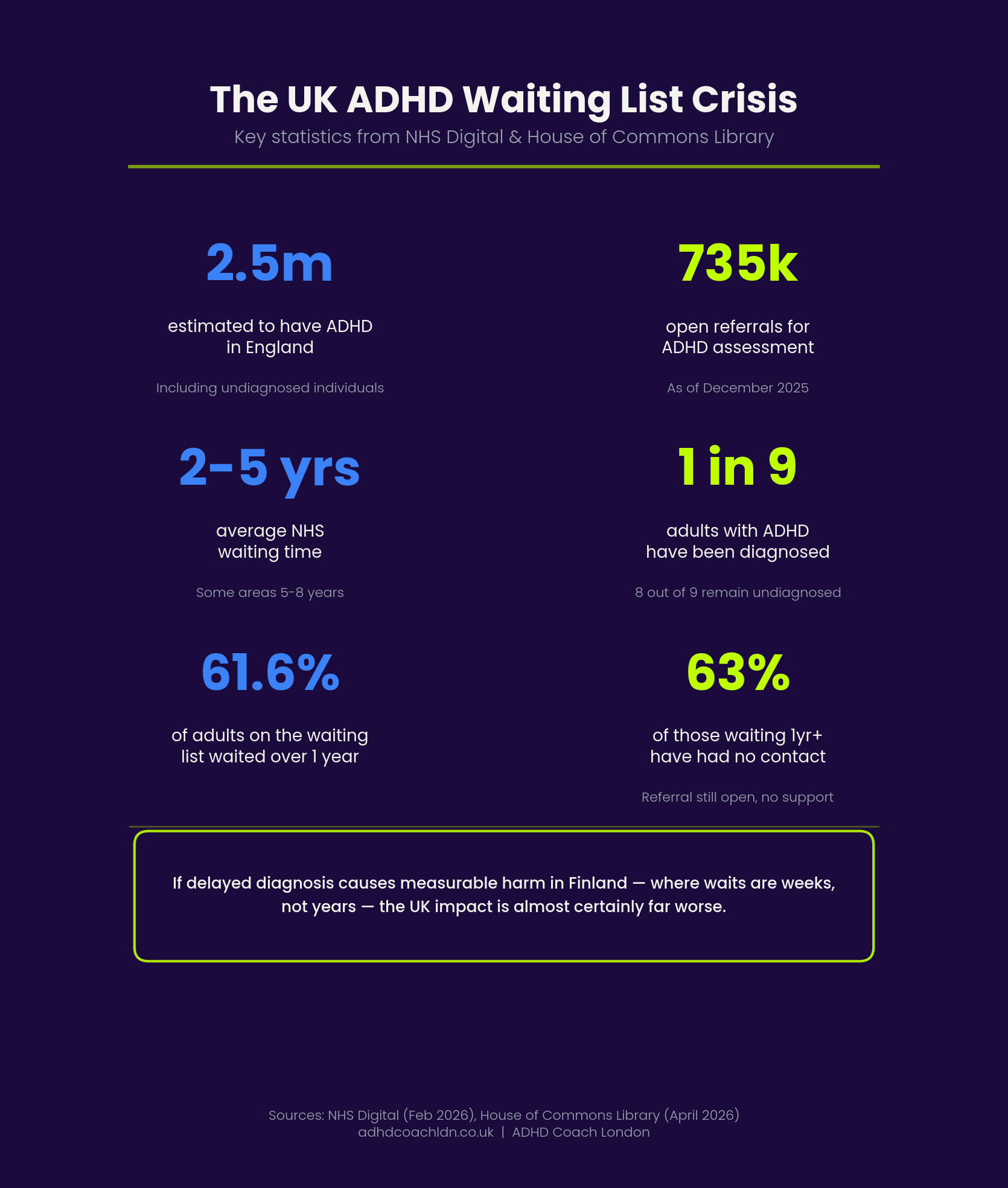
The implications are urgent, especially in the UK, where over 735,000 people are waiting for assessment, with waits of 2 to 8 years. This post breaks down what the data actually shows, what it means for the UK, and what you can do right now, whether you have a diagnosis or not.
What the Research Tells Us About Timing
The Volotinen et al. (2026) study is the largest to date. Having an ADHD diagnosis at any age was associated with lower academic performance, higher dropout rates, and reduced likelihood of pursuing academic education.
The key finding is that when your diagnosed is important. Three key patterns emerged:
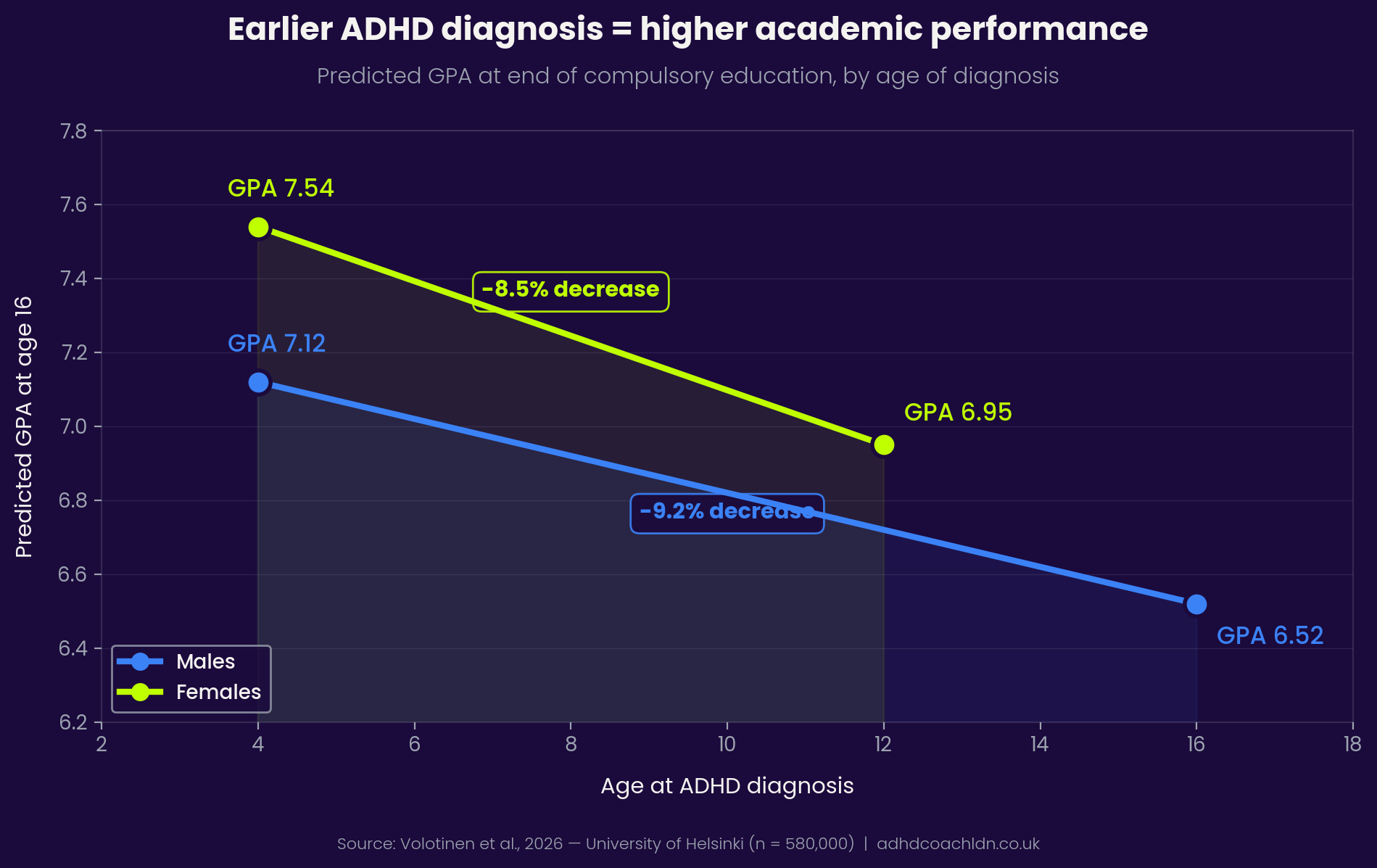
1) Earlier diagnosis = higher academic performance
Students diagnosed at age 4 had predicted GPAs roughly 8–9% higher than those diagnosed in their teens. For UK readers: this is the difference between GCSE grades that open doors and grades that close them.
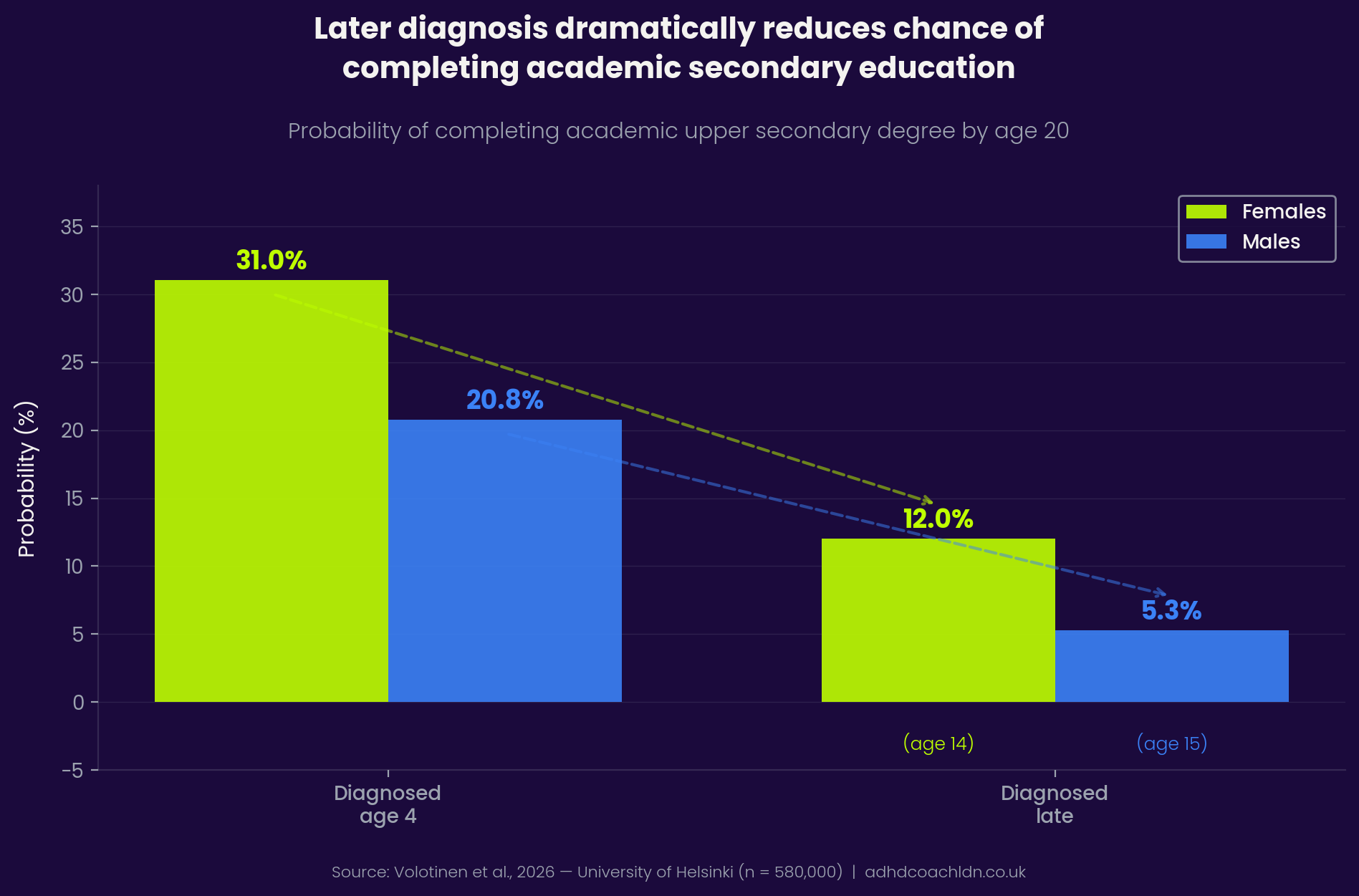
2) Later diagnosis dramatically reduces academic completion
The probability of completing academic secondary education by age 20 dropped sharply with later diagnosis. For females: from 31% (diagnosed age 4) to just 12% (diagnosed age 14). For males: from 21% down to 5%.
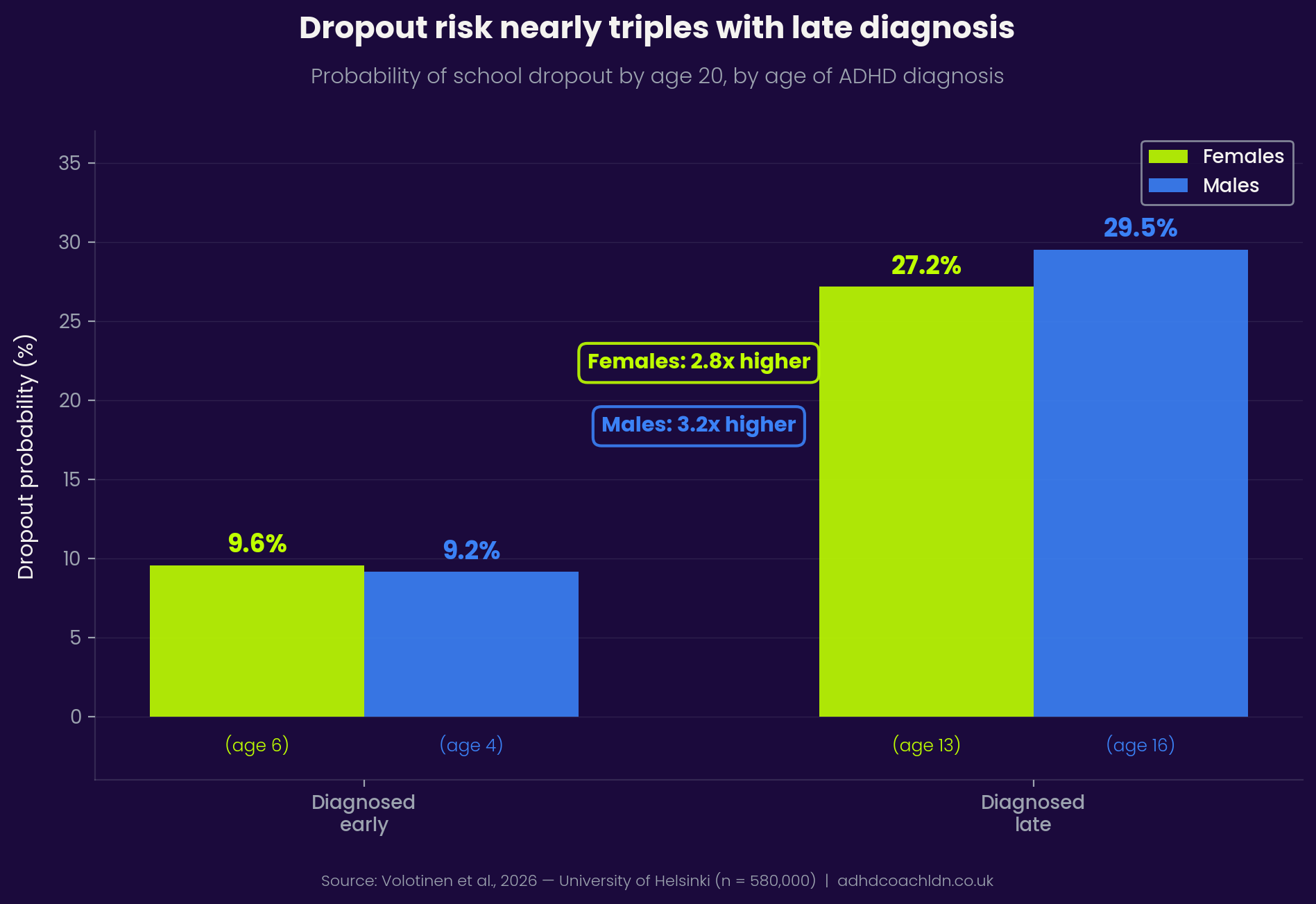
3) Dropout risk nearly triples
For males diagnosed at 16 rather than 4, dropout probability jumped from 9% to nearly 30% — a 3.2x increase. Close to one-third of this late-diagnosed group were not in any form of secondary education by age 20.
What Does This Mean Beyond Finland?
Finland has one of the world’s strongest education and healthcare systems. Referral-to-treatment times are measured in weeks, not years.
If delays cause this much damage there, the UK picture — where waiting lists stretch 2–5 years on average, services are fragmented, and adult ADHD support is routinely described as being “in crisis” — is almost certainly worse.
The UK Waiting List Crisis
The scale of the UK’s ADHD assessment backlog is staggering:
When clients come to coaching during the waiting period, the emotional burden is palpable. Some have struggled for years with coping mechanisms that no longer work. Early intervention is key — but with waiting lists this long, coaching should be offered to support people while they wait.
The Cost of Late Diagnosis: Education, Career, Health and Life
A late ADHD diagnosis isn’t a single setback. Each year of delay compounds — widening the gap between where you are and where you could be. The NHS taskforce estimates the annual economic cost of unsupported ADHD at around £17 billion to the UK economy.
Education:
Later diagnosis indicates lower academic performance and a reduced likelihood of academic education
For UK readers: this translates directly into GCSE results, A-level choices, and university access
A child diagnosed and supported at 8 has a measurably different trajectory from the same child at 15, by which point years of underperformance and “I’m not academic” messaging have shaped their self-image
Career & Earnings:
ADHD is linked to higher unemployment rates, lower occupational status, and greater financial instability (Jangmo et al., 2021, PLoS One)
Adults with undiagnosed ADHD are more likely to experience job loss, underemployment, and impulsive financial decisions
In the US, the social cost of adult ADHD has been estimated at $122.8 billion, driven primarily by productivity losses (Schein et al., 2022)
These costs build on each other. Struggles in education lead to career challenges, which in turn cause financial problems, making it harder to access private diagnosis and support. The cycle reinforces itself.
Physical & Mental Health:
More than half of adults with ADHD also have at least one other mental health condition, usually anxiety or depression
For those diagnosed late, there’s a painful pattern: years of treatment for anxiety, depression, or personality disorders that only address symptoms while the underlying ADHD goes unnoticed
A cohort study of 30,000 UK adults found ADHD was associated with a reduction in life expectancy of approximately 7 years for men and 9 years for women (O’Nions et al., 2025, British Journal of Psychiatry)
The researchers attributed this not to ADHD itself, but to modifiable risk factors: smoking, poor physical health management, mental health comorbidities, and lack of access to treatment
Key takeaway: these problems aren’t an automatic result of having ADHD. They happen when ADHD goes unsupported.
The Invisible Costs:
There are daily costs that studies can’t measure:
Food that goes off because you forgot about it
Bills paid late, parking fines that stack up
Friendships that fade because maintaining them requires planning
Careers never pursued because you believed you “weren’t the kind of person who could do that”
These costs add up quietly. Because they aren’t measured, they’ve never been used to argue for faster diagnosis, even though early help could prevent most of them.
Why Women Pay a Higher Price
The Volotinen study confirms what clinicians have observed for years: females are diagnosed later. In the Finnish cohort, the mean age at diagnosis was 11 for males and 14 for females. Three years might not sound like much, but the data shows it leads to very different outcomes.
The reasons are well documented:
Girls with ADHD more often present with inattention rather than hyperactivity; quieter, less disruptive, less likely to be referred
They mask by working harder, which is praised rather than questioned. A girl who stays up late to finish homework others complete quickly isn’t seen as struggling; she’s called “diligent”
By the time these coping strategies collapse, often at university, a first job, or parenthood, the costs have compounded for years
In the UK, women are now the fastest-growing group seeking adult ADHD assessments. Many are in their 30s, 40s, or 50s and have spent most of their adult lives being treated for anxiety and depression. The ADHD was always there.
The first thing I notice with these clients is the tiredness. They can’t push any harder or juggle anything more. They’ve been spinning 40 plates, and the cascade of plates smashing led them to seek a diagnosis. They masked and worked late to achieve the same results as their peers. When they realise it was ADHD, there’s a period of grief. What might have been different? Coaching helps them break down years of masking so they can finally build a life that works for their brain.
What You Can Do While You Wait
You don’t need a formal diagnosis to start making changes. Here are two things you can act on today.
1. Understand your brain before the system does
A diagnosis is a label. Understanding yourself is a tool. While you wait, start noticing your patterns. Ask yourself:
How do I currently manage tasks? What breaks down first?
When do I have the most energy? When the least?
What do I always forget, even when I remind myself repeatedly?
When have I performed at my best? What was different about that environment?
What am I genuinely good at?
Other Useful Tools:
WHO’s Adult ADHD Self-Report Scale (ASRS).
Reputable organisations like ADHD UK, CHADD, and ADDitude Magazine provide evidence-based information.
Knowledge isn’t a diagnosis, but it’s something you can use right away.
2. Build systems, not willpower
If the usual advice — plan ahead, use a planner, try harder — hasn’t worked, it’s not a personal failing. It means your brain needs a different approach. You don’t have to wait years to start building one.
Audit your environment. Where are you losing time, money, or energy to systems that assume neurotypical executive function? Those are your highest-ROI intervention areas.
Build external supports. Alarms, visual cues, body doubling, and accountability partners aren’t crutches; they’re performance tools.
Design for your worst days. ADHD symptoms fluctuate. A system that only works when you’re at your best isn’t a system. Start with a routine you can manage on your hardest day.
Consider coaching as an intervention. If the research shows earlier support improves outcomes, starting coaching before or during the diagnostic process is one of the most effective decisions you can make. It doesn’t require a diagnosis — just a willingness to understand how your brain works.
What the Research Doesn’t Say (An Important Note)
The Volotinen study is observational. It shows that earlier diagnosis is linked to better outcomes, but it does not prove that earlier diagnosis causes them. The researchers acknowledge this and call for further investigation. But the evidence points in a clear direction, the biology makes sense, and waiting for perfect proof before acting has its own cost. Getting diagnosed at any age is valuable. A late diagnosis is never “too late”, but the data makes a compelling case that earlier is better, and that the system needs to move faster.
Conclusion
The Finland study adds large-scale evidence to something the ADHD community has long known: the timing of your diagnosis shapes your trajectory. When you overlay the UK’s own numbers — 735,000 people waiting, 2–5 year average waits, 7–9 years of reduced life expectancy for unsupported adults — the picture is stark.
But the data also offers hope. Much of the cost comes from modifiable factors and unmet support needs. Taking action at any stage makes a difference.
Learn how your brain works. Build systems that fit. Seek coaching and support now, not after a diagnosis.
The system should move faster. But you don’t have to wait for it to catch up.
If this resonated, I write about ADHD, performance, and the strategies most people don’t talk about in my newsletter.
Subscribe on Substack →
Want personalised support? Explore working with me →