
ADHD and Time Blindness: Why You’re Not Bad at Time”
You lead a team. You hit targets. You've built a career that, by most standards, seems successful.
And yet you're still late to the 10 am meeting. You still underestimate how long the board deck will take by a factor of three. You still can't explain why an entire afternoon vanished into a task that should have taken forty minutes.
You've tried harder. You've bought planners. You've set alarms. And still, your relationship with time feels fundamentally broken.
Here's what nobody told you: it's not a discipline problem. It's a brain wiring problem. And it has a name.
What Time Blindness Is
Time blindness is the inability to accurately perceive the passage of time, estimate how long tasks will take, or feel the reality of a future deadline. The term was coined by Dr Russell Barkley, one of the most cited ADHD researchers worldwide, and it describes something that most people with ADHD recognise instantly.
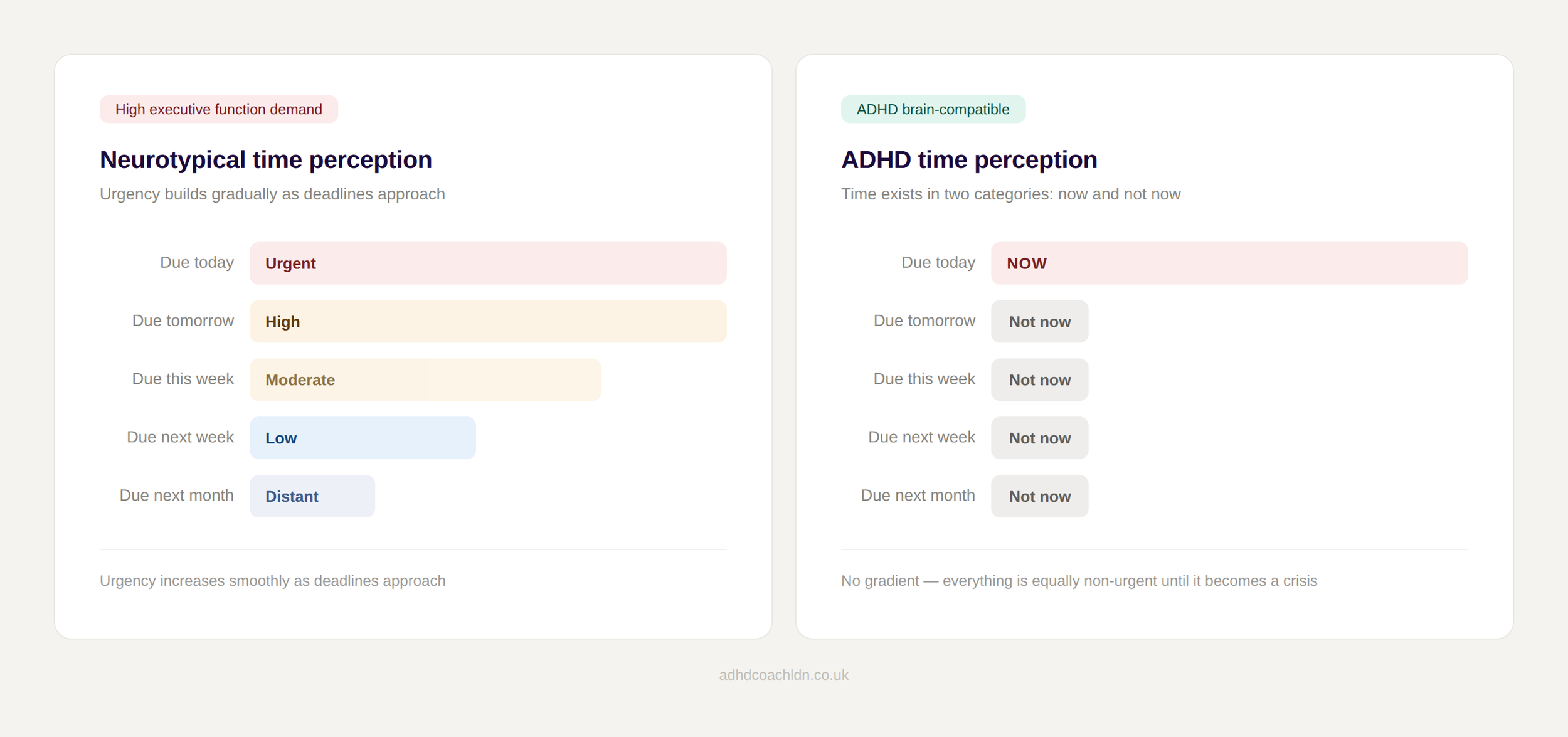
For neurotypical individuals, time has an inherent texture. An hour feels like an hour. A deadline next Thursday gradually becomes more urgent as the days pass. Tuesday afternoon "feels" different from Friday morning.
For people with ADHD, time tends to exist in just two categories: now and not now. A deadline next Thursday and one next quarter can seem equally distant until one of them suddenly becomes now, and panic kicks in.
This isn't metaphorical. It's neurological.
The Neuroscience
Three things happen in the ADHD brain that directly affect how you experience time.
1) Your dopamine system works differently.
Dopamine is the chemical in the brain that influences motivation, reward, and attention. Brain imaging studies (using PET scans) have found that people with ADHD have measurably lower dopamine activity in the brain's reward pathway, specifically in an area called the nucleus accumbens. This is important because dopamine helps make future rewards feel real and immediate. When dopamine levels are low, a deadline three weeks away might not seem urgent. It's not that you don't care; it's that your brain isn't signalling urgency.
2) Your internal clock runs fast.
Research consistently indicates that people with ADHD overestimate how much time has passed during short intervals and underestimate it during longer ones. What feels like ten minutes might be twenty. What seems like an hour-long meeting could be only thirty minutes. Your subjective experience of time genuinely differs from the clock on the wall.
3) Your executive function system — the brain's project manager — is affected.
Time perception falls within what researchers call the "activation" cluster of executive functions: organising, prioritising, estimating time, and getting started. In ADHD, this cluster is impaired. That's why you can be exceptionally capable at strategic thinking and still chronically underestimate how long a quarterly review will take to prepare.
Why This Matters More at the Senior Level
Here's what most ADHD content fails to mention: time blindness doesn't become easier as you advance your career. It becomes more challenging.
Your calendar is less forgiving. At the junior level, being ten minutes late to a meeting is awkward. At the VP level, it signals disrespect. At SVP and above, it costs you credibility. The margins for error shrink as the stakes rise.
You're managing other people's time, not just your own. When you underestimate how long a strategy session will take, it's not just your afternoon that's disrupted, it's your entire team's. When you're late to a client call, your direct reports notice. Time blindness at the senior level has a multiplier effect.
The work is less structured. Earlier in your career, deadlines were assigned to you. Now you set them. Meetings had agendas you followed. Now you create them. The external scaffolding that quietly compensated for your time blindness has gradually been removed, and you are expected to provide your own. For a brain that struggles with time, greater autonomy can paradoxically lead to poorer performance.
The stakes of procrastination are higher. Avoiding a university essay can be stressful. Delaying a board paper or restructuring decision has serious implications for people's jobs, your company's strategy, and your reputation. Nonetheless, the core mechanism remains the same: your brain cannot perceive a future deadline as real until it becomes an immediate crisis.
What Time Blindness Looks Like in Practice
If you're a senior professional with ADHD, you might recognise some of these patterns:
You consistently underestimate how long tasks take, even tasks you've done dozens of times before
You arrive at meetings having "just quickly" tried to finish something else, and you're five minutes late again
Your PA or EA has learned to tell you that meetings start fifteen minutes earlier than they actually do
You say yes to commitments without checking your calendar, because each one feels manageable in isolation
You hyperfocus on a piece of work you find interesting while something more urgent sits untouched
You can only begin certain tasks when the deadline pressure becomes intense — and then you create exceptional work under great stress.
You feel genuine surprise when you look at the clock and hours have passed
None of this indicates that you're bad at your job. Research published in JAMA confirms that these patterns are linked to measurable differences in brain chemistry, not to intelligence, competence, or commitment.
What Actually Helps
The research is clear: willpower and good intentions are not the answer. The solution is creating external systems that do what your internal clock cannot.
Make Time Visible
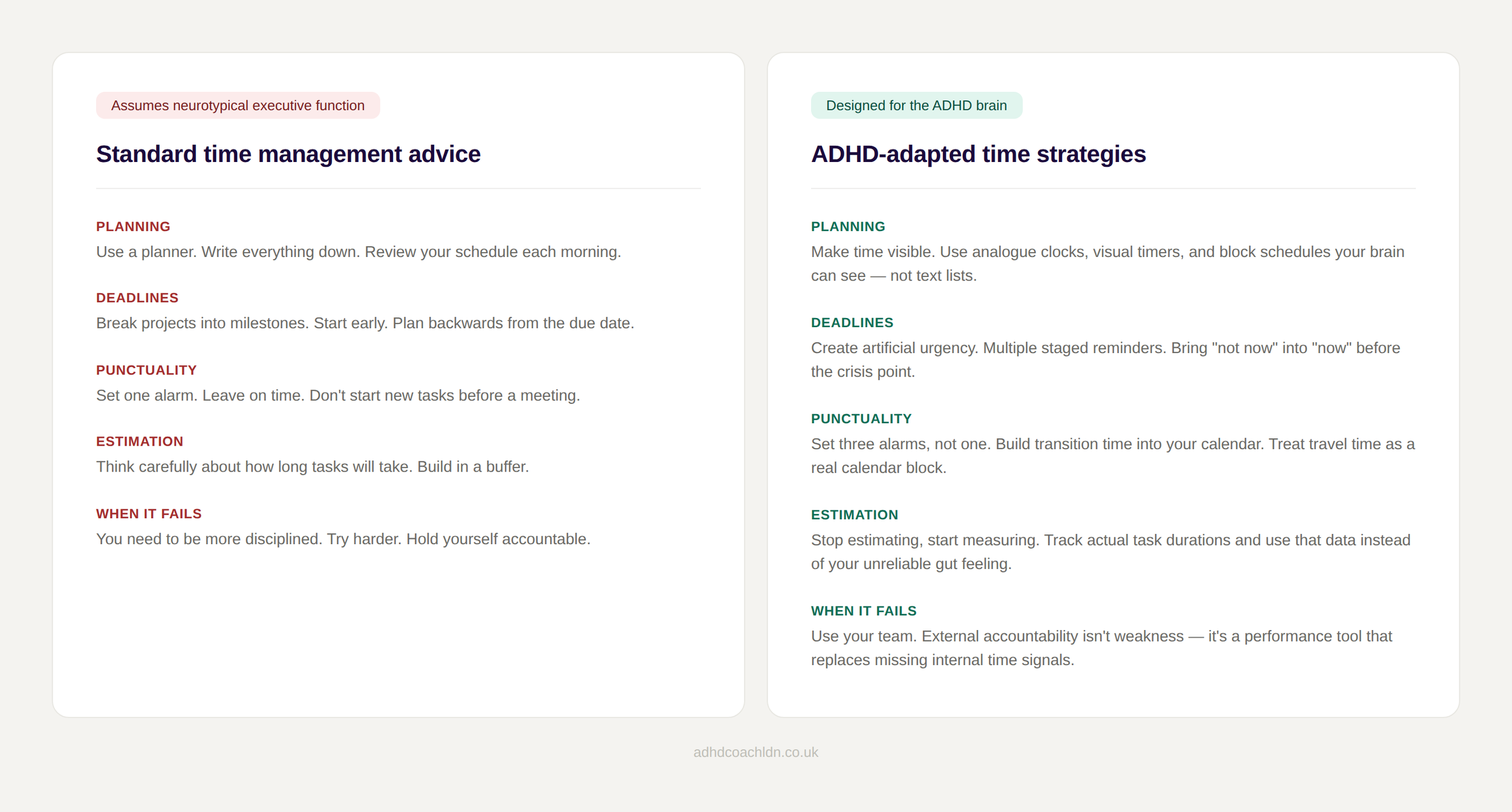
Your brain doesn't naturally feel time passing, so make it something you can see. Use visual timers (like the Time Timer, which shows a coloured disc that shrinks as time passes). Keep an analogue clock visible — it gives you a spatial picture of where you are in the hour, the morning, the day. Set your digital calendar to display your day as a visual block schedule, not just a list.
Use Alarms Strategically
Not one alarm. Multiple reminders. If you need to leave for a meeting at 2 pm, set alerts at 1:30, 1:45, and 1:55. If you have a deadline on Friday, set a reminder on Monday to start, Wednesday to check progress, and Thursday morning for the final review. The aim is to create artificial urgency signals that your dopamine system doesn't generate naturally.
Build in Transition Time
One of the most common time traps for senior leaders with ADHD is back-to-back scheduling. You need buffer time — not because you're slow, but because your brain doesn't naturally shift gears between tasks. Allocate 10-15 minutes between meetings. Consider travel time as an actual calendar entry, not something you'll figure out later.
Stop Estimating; Start Measuring
Your time estimates are unreliable. This isn't a criticism; it's a matter of neurology. Start tracking how long tasks actually take and rely on that data instead of your gut feeling. If your quarterly report has consistently taken six hours, stop telling yourself it'll take three this time.
Use Your Team
This isn't about delegation as a leadership skill; it's about creating a support system. A good EA who understands ADHD is worth their weight in gold. A direct report who sends you a "heads up, the board pack is due in three days" message isn't nagging; they're providing the external time signal your brain needs. Let those around you help.
Reframing the Narrative
If you've spent your career compensating for time blindness, apologising for lateness, working through the night to meet deadlines you should have started earlier, and feeling secretly ashamed that someone at your level still can't "manage their time", I want to be direct with you.
This is not a character flaw. It is a measurable neurological difference. PET scans can see it. Decades of peer-reviewed research confirm it. The same brain wiring that makes you exceptional at crisis thinking, pattern recognition, and creative problem-solving is the brain wiring that makes Tuesday's deadline feel fictional until Monday night.
You are not bad at time. Your brain processes time differently. And once you stop trying to fix yourself and start building systems that work with your brain, everything changes.
If you're a senior professional navigating ADHD in the workplace and want support building strategies that actually work, [get in touch / learn more about how I can help]. You don't need another productivity hack — you need an approach designed for how your brain works.